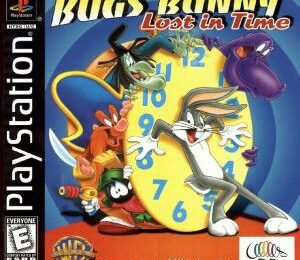
Bugs Bunny: Lost in Time

Bugs Bunny: Lost in Time is a 1999 platform video game developed by Behaviour Interactive, published by Infogrames, and released for the PlayStation and Microsoft Windows. It is based on the Bugs Bunny and Looney Tunes characters by Warner Bros. Entertainment. The game follows the titular character, who finds himself in a time slip and is tasked with gathering clocks in order to return to the present.

An indirect sequel, Bugs Bunny & Taz: Time Busters was released for the same platforms in November of the following year.

Plot
The game stars Looney Tunes cartoon character Bugs Bunny, who finds and activates a time travel machine (mistaking it for a carrot juice dispenser) after taking a wrong turn at Albuquerque intended for Pismo Beach. He ends up in Nowhere, home of a sorcerer named Merlin Munroe. Merlin then informs Bugs that he is lost in time, and that he must travel through five different eras of time in order to collect clock symbols and golden carrots, which will allow him to return to the present.

Gameplay
The game finds the player (Bugs Bunny) in a race to collect time clocks. To progress in the game, Bugs must complete stages and various objectives which earn them; stages may also contain clocks out in the open in which Bugs can collect, as well as golden carrots. If the player meets a certain threshold of clocks or golden carrots, they’ll be able to unlock new stages or a new time era (serving as the game’s hub worlds), which become accessible by means of a time machine.

The player starts off in an area titled “Nowhere”, which acts as a tutorial level; Bugs will learn the basic moves he needs to use to progress through the game. He can kick, jump, pick up objects, roll, jump into rabbit holes to move underground, tiptoe to avoid alerting other enemies, climb ropes, and use his rabbit ears like propellers to slowly descend to the ground from high places. Bugs can also move some objects to get to certain places. Enemies in the game are mostly simple to beat. Some can be defeated with a kick or a jump, while others may require Bugs to be chased by an enemy until they run out of breath, then they can be kicked in the back. There are also special abilities for Bugs to learn from Merlin much later as he progresses through the game.

While in the time machine, there are five different eras (spanning 21 levels in total) for Bugs to visit. They are the Stone Age, Pirate Years, The 1930s, Medieval Period, and Dimension X. Each level has a varying amount of clock symbols and golden carrots for Bugs to find. There are also normal carrots for Bugs to pick up, which act as his health. Carrots can be collected by finding them scattered in a level. He can hold up to 99 carrots. After completing a level, Merlin will appear and the player can decide if they wish to save their progress up to that point.
Tagged : / /

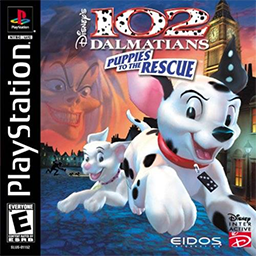
102 Dalmatians – Puppies to the Rescue

Disney’s 102 Dalmatians: Puppies to the Rescue is a platform video game developed by Crystal Dynamics and published by Eidos Interactive for Microsoft Windows, PlayStation, Dreamcast, and Game Boy Color. It is loosely based on the live-action Disney movie 102 Dalmatians.

Plot

Story

Console version

Two Dalmatian puppies, Oddball and Domino, are out in the backyard looking for treasure. They find a toy buried in a park that was made at one of Cruella de Vil’s toy factories; this alludes to the fact that Cruella’s toy sales are down. Facing financial ruin from lack of sales, Cruella sets a plan in motion: to reprogram her toys to capture any pets in sight so she can freeze them in “Super-Gloop” and sell them as a new line of realistic animal toys. Oddball and Domino are the only puppies in their family who have not been captured when they return from the park. Their parents, Dottie and Dipstick, set out to rescue their puppies, commanding Oddball and Domino to stay home. Instead, the puppies set out to save their siblings, and their parents, who are captured along the way.

Game Boy Color version

Cruella de Vil has reprogrammed the toys of her toy factory into kidnapping all the Dalmatian puppies and locking them in cages to power the factory once they get older. Two of the puppies, Oddball and Domino, were able to escape through their cages due to their small size and must free the puppies and escape the factory.

Setting

Similar to the film, the game is set in London, England. There are various levels in the game that are based on well-known places or monuments such as Regent’s Park, Piccadilly, Big Ben, and Stonehenge.

Gameplay

The player can choose the role of Domino (voiced by Frankie Muniz in console versions) or Oddball (voiced by Molly Marlette). Over the course of the game, the player has several opportunities to collect ‘stickers’ towards a virtual sticker book which can be accessed through the level menu. Various actions within the game will unlock stickers. Generally, there is a sticker for exiting every level, collecting 100 bones at each level, and rescuing all the puppies at each level. Each level has its own individual tasks which will also grant stickers: completing a chore, defeating a henchman, and solving puzzles. There are six stickers per level, excluding Cruella levels, which combine together with mini-games for their own sticker image. The stickers are like puzzle pieces that create a realistic picture.

Puppies to the Rescue is a 3-dimensional game with the ability to angle the camera in whichever direction will make it easiest for navigation. The player must avoid and bark at enemy toys to short-circuit them or tumble into them to smash them.

Checkpoints within a level are places where the player will be sent back if a life is lost and are marked by a parrot named Waddlesworth. If a toy hurts the player four times, a life is lost. If a checkpoint has not been reached before a life is lost, the player is sent back to the starting point. Unlike the Game Boy Color version of the game where the toys are active after being broken, toys the players break stay broken. To regain lost health, the player can collect food.

Each level has a ‘spirit animal friend’ who will tell the player how to get through the level, and sometimes assign Oddball or Domino-specific tasks to do in return for a reward or assistance. Certain levels also feature one of Cruella’s three main henchmen from both films: Jasper and Horace from 101 Dalmatians, and Le Pelt from 102 Dalmatians. Unlike enemy toys, they are invincible from normal attacks and the player must perform a certain task instructed by the level’s animal friend in order to defeat them. After a specific number of levels has been completed, the player will face Cruella in a series of boss battles which will unlock a minigame to play upon completion.

Tagged : / /

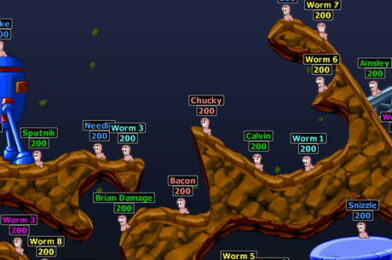
Worms Armageddon

Worms Armageddon is a 1999 turn-based strategy video game developed and published by Team17. It was originally released for the Microsoft Windows operating system, and was later ported to the PlayStation, Dreamcast, Nintendo 64, and Game Boy Color. Worms Armageddon is the third installment in the Worms series. In the game, the player controls a team of up to eight earthworms tasked with defeating an opposing team using a wide range of weapons at their disposal. The game takes place on a destructible and customizable two-dimensional board and is characterized by cartoonish graphics and a unique brand of humor.

Worms Armageddon was originally developed as an expansion pack to Worms 2 and initially titled Wormageddon before it was released as a standalone game. Worms Armageddon was acclaimed by critics, who praised the refined gameplay and stylized graphics, and it has been featured in a number of “greatest games of all time” lists. Worms Armageddon is still updated periodically as of 2020, and was released on the Steam platform in 2013.

Tagged : /

Ghosts ‘n Goblins

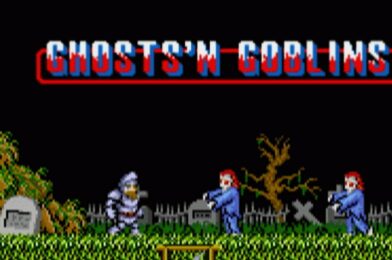
Ghosts ‘n Goblins (Japanese: 魔界村, Hepburn: Makaimura, lit. Demon World Village) is a run and gun platform game created by Tokuro Fujiwara and developed by Capcom. The first entry in the series was Ghosts ‘n Goblins, released in arcades on September 19, 1985. The series has subsequently been ported to and released on a variety of game consoles and mobile platforms and spawned several sequels and spin-offs.

The main series focuses on the knight Arthur‘s quest to save princess Prin-Prin from the demon king Astaroth. The primary spin-offs include the Gargoyle’s Quest and Maximo game series.

The series as a whole has sold over 4.2 million units and stands as the 13th best-selling Capcom game franchise. It has gained a reputation among players for its high level of difficulty

The most recent game in the series, Ghosts ‘n Goblins Resurrection, was released on February 25, 2021.

Tagged : / / /

Asterix

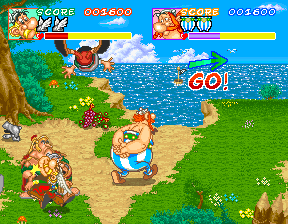
Asterix is a horizontal-scrolling beat’em up arcade game released in 1992 by Konami. It is based on the French comic series Asterix and Obelix. The player fights as either Asterix the Gaul or his best friend, Obelix, as they take on the ‘might’ of the oppressive Roman Empire. Asterix includes a variety of humorous fighting moves, which are demonstrated in the game’s attract mode. The artwork and feel of Asterix remains true to its French source material, and the game’s many humorous touches (such as the way defeated Legionnaires crawl away) will be instantly familiar to fans of the comic-book and cartoon series. Bonus levels – such as the chariot race that awaits at the end of the first level – introduce different gameplay elements to provide a break from the fighting. Despite this game being developed by a Japanese company, all text in the game is either in English or French.

Tagged : / /

Tom & Jerry (and Tuffy)

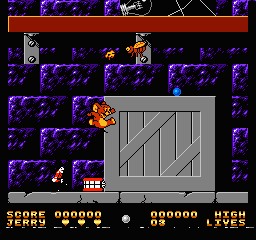
A Tom and Jerry video game (also known as Tom and Jerry: The Ultimate Game of Cat and Mouse! or Tom and Jerry (and Tuffy)) was released by Hi Tech Expressions for the Nintendo Entertainment System in 1991 and for MS-DOS in 1993. Tom has mouse-napped Jerry’s nephew Tuffy and locked him in a trunk in the attic. Usable weapons include bubble gum, meat cleaver, cups of water, moth balls, hammer, invisible ink and drill.

Tagged : / /

Ice Climber

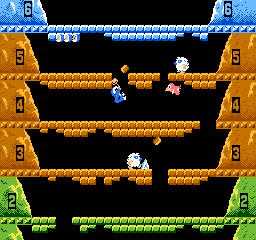
Ice Climber is a vertical platform video game developed and published by Nintendo for the Nintendo Entertainment System in 1985. In Ice Climber, the characters Popo and Nana, (Also known as Pepe and Nana in the German version) collectively known as the Ice Climbers, venture up 32 ice-covered mountains to recover stolen vegetables from a giant condor. In some European countries, the NES console was sold bundled with the game, increasing Ice Climbers familiarity outside Japan.

An alternate version was released in the arcades as part of the Vs. series, known as Vs. Ice Climber. It includes gameplay features not found in the home console release, such as an animated title screen, a stage select menu which appears at the start of the game and after completing each level, 16 additional mountains, occasional blizzard and wind effects, more enemy characters, and bonus multiplier items.

The inclusion of Nana and Popo as playable characters in the 2001 GameCube title Super Smash Bros. Melee brought the game renewed attention. Nintendo released a version of the game for the Nintendo e-Reader in 2002.

Tagged : /

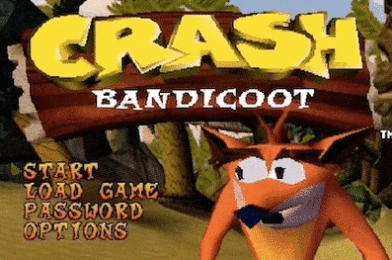
Crash Bandicoot

Crash Bandicoot is a 1996 platform video game developed by Naughty Dog and published by Sony Computer Entertainment for the PlayStation. It is the first installment in the Crash Bandicoot series, chronicling the creation of the title character at the hands of series antagonist Doctor Neo Cortex and henchman Doctor Nitrus Brio. The story follows Crash as he aims to prevent Brio and Cortex’s plans for world domination, and rescue his girlfriend Tawna, a female bandicoot also evolved by Cortex and Brio.

Crash Bandicoot was released to generally positive reviews from critics, who praised the game’s graphics and unique visual style but criticized its controls and lack of innovation as a platform game. The game went on to sell over 6 million units, making it the eighth best-selling PlayStation game, and the highest-selling ranked on sales in the United States. A remastered version, included in the Crash Bandicoot N. Sane Trilogy collection, was released for the PlayStation 4 in June 2017 and ported to other platforms the following year.

Tagged : / / /

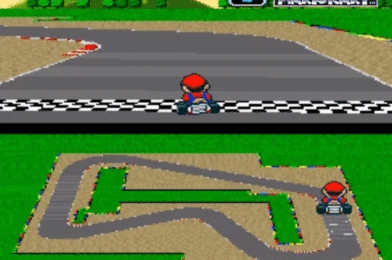
Super Mario Kart

Super Mario Kart is a 1992 kart racing video game developed and published by Nintendo for the Super Nintendo Entertainment System video game console. The first game of the Mario Kart series was released in Japan and North America in 1992 and in Europe the following year in 1993. Selling 8.76 million copies worldwide, the game went on to become the fourth best selling SNES game of all time. Super Mario Kart was re-released on the Wii‘s Virtual Console in 2009, and on the Wii U‘s Virtual Console in 2013. Nintendo re-released Super Mario Kart in the United States in September 2017 as part of the company’s Super NES Classic Edition.

In Super Mario Kart, the player takes control of one of eight Mario series characters, each with differing capabilities. In single player mode, players can race against computer-controlled characters in multi-race cups over three difficulty levels. During the races, offensive and speed boosting power-ups can be used to gain an advantage. Alternatively, players can race against the clock in a Time Trial mode. In multiplayer mode, two players can simultaneously take part in the cups or can race against each other one-on-one in Match Race mode. In a third multiplayer mode – Battle Mode – the aim is to defeat the other players by attacking them with power-ups, destroying balloons that surround each kart.

Super Mario Kart received positive reviews and was praised for its presentation, innovation, and use of Mode 7 graphics. It has been ranked among the greatest video games of all time by several organizations including Edge, IGN, The Age, and GameSpot, while Guinness World Records has named it the top console game ever. It is often credited with creating the kart-racing subgenre of video games, leading other developers to try to duplicate its success. The game is also seen as having been key to expanding the Mario series into non-platforming games. This diversity has led to it becoming the best-selling game franchise of all time. Several sequels to Super Mario Kart have been released, for consoles, handhelds, and arcades, each enjoying critical and commercial success. While some elements have developed throughout the series, the core experience from Super Mario Kart has remained intact.

Tagged : / / / /

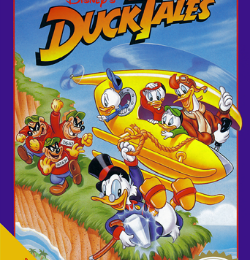
Duck Tales

DuckTales is an action platformer video game developed and published by Capcom and based on the Disney animated TV series of the same name. It was first released in North America for the Nintendo Entertainment System in 1989 and was later ported to the Game Boy in 1990. The story involves Scrooge McDuck traveling around the globe collecting treasure and outwitting his rival Flintheart Glomgold to become the world’s richest duck.

Produced by key personnel from the Mega Man series, DuckTales would go on to sell over a million copies worldwide on each system, becoming Capcom’s best-selling title for both platforms. The game was praised for its tight control, unique and non-linear gameplay, and bright presentation, and is often regarded as one of the best titles for the NES, appearing on numerous “Best of” lists.

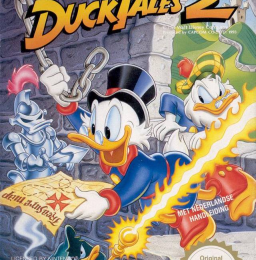
DuckTales was followed by a sequel, DuckTales 2, in 1993. A Remastered version of DuckTales developed by WayForward Technologies, featuring high-resolution graphics and performances by the surviving members of the show’s voice cast, was released in 2013 for PC, Xbox 360, PlayStation 3, and Wii U. The original 8-bit version of the game was also included in The Disney Afternoon Collection compilation for PC, PlayStation 4, and Xbox One.

Tagged : /

Prince of Persia

Prince of Persia is a fantasy cinematic platformer designed and implemented by Jordan Mechner for the Apple II and published by Broderbund in 1989. Taking place in ancient Persia, players control an unnamed protagonist who must venture through a series of dungeons to defeat the Grand Vizier Jaffar and save an imprisoned princess.

Much like Karateka, Mechner’s first game, Prince of Persia used rotoscoping for its fluid and realistic animation. For this process, Mechner used as reference for the characters’ movements videos of his brother doing acrobatic stunts in white clothes and swashbuckler films such as The Adventures of Robin Hood.

The game was critically acclaimed, but not an immediate commercial success as it was released at the tail end of the Apple II’s relevance. It sold many copies as it was ported to a wide range of platforms. It is believed to have been the first cinematic platformer and inspired many games in this subgenre, such as Another World. Its success led to the release of two sequels, Prince of Persia 2: The Shadow and the Flame and Prince of Persia 3D, and two reboots of the series, first in 2003 with Prince of Persia: The Sands of Time, which led to three sequels of its own, and then again in 2008 with the identically-titled Prince of Persia.

Tagged : / /