Dune 2000

Dune 2000 is a real-time strategy video game, developed by Intelligent Games and published by Westwood Studios in 1998 for Microsoft Windows. It was later ported to the PlayStation in 1999.[4] It is a partial remake of Dune II, which is loosely based on Frank Herbert’s Dune universe.[5] The story of the game is similar to Dune II, and is continued in Emperor: Battle for Dune.

Gameplay
The player commands of one of three Houses and must fight for control of the spice mélange on the planet Arrakis. The player harvests spice for ‘solaris’, the in-game currency, and uses the solaris to make units to supply their forces. Dune 2000 features an interface and gameplay similar to Command & Conquer: Red Alert, where unlike in Dune II, the player can control more than one unit at a time.

In-game screenshot; the player’s base with units is visible.
Like most real-time strategy games, the game map initially starts with a black fog of war covering the entire map, with an exception to units’ line of sight. As the units explore the map, the fog is removed for the duration of the mission, allowing the player to observe activity in those regions even if they do not have any units with line of sight to them. Like Dune II, the player may construct concrete before placing buildings. In Dune II, all buildings would deteriorate regardless, but the concrete foundations slowed the process. However, in Dune 2000, the buildings do not deteriorate over time when built in their entirety on concrete.

Although each house has many common units, such as infantry, Wind Traps, and Mobile Construction Vehicles, each House also has its own set of units, such as the Atreides Sonic Tank, the Ordos Deviator and the Harkonnen Devastator. Houses Harkonnen and Atreides share the Trike, while House Ordos has an upgraded version, the Raider. Like many games of the Westwood franchise, a player can gain access to other Houses’ special units by capturing an enemy building that can manufacture the desired units. House Ordos can obtain the Missile Tank by ordering it from the Starport when it would otherwise be inaccessible. After patch 1.06, the Harkonnen can eventually train the Sardaukar, which are soldier-fanatics loyal to the Corrino Emperor.

Cinematics
The game also features live action cinematics that play before each mission for the three different factions as well as for the introduction.

Synopsis
Emperor Corrino (Adrian Sparks) has issued a challenge that the House which can produce the most spice will control its source, the desert planet Dune, with no rules as to how the Houses can achieve the goal. Meanwhile, Lady Elara (Musetta Vander) of the Bene Gesserit and bound concubine to the Emperor, secretly takes the commander – the player – into one of the Heighliners, a person whose bloodline and future the Sisterhood had checked. According to Elara, they saw many visions of the commander dying — and only in one vision does the commander live and even rise to control massive armies and bring peace to Arrakis.

As in Dune II, the three main playable factions are House Atreides, House Harkonnen and House Ordos. There are also four non-playable subfactions: House Corrino, the Fremen, the Mercenaries and the Smugglers.

House Atreides
Hailing from the water-planet of Caladan, the Atreides have a strict loyalty to their Duke and follow him with zeal. The Duke’s famous Mentat, Noree Moneo (John Rhys-Davies), advises and resides over the Duke’s forces on Arrakis. The House’s fleets of ornithopters ensure their superior air power backed by Sonic Tanks to humanely destroy enemies. The Duke also wishes to develop an alliance with the Fremen, the native warriors of Dune.
House Harkonnen
The Harkonnens are ruled by the wicked Baron and come from the volcanic waste-planet of Giedi Prime. According to Lady Elara, the only thing human about the Harkonnen is their genetic makeup, as all humanity was abandoned long ago in favor of brutality and maliciousness, favoring pure firepower brought by Devastator Tanks and the Death Hand Missile. The Baron’s Mentat, Hayt De Vries (Robert Carin), was born from the flesh of a dead man in the Tleilaxu Flesh Vats.
House Ordos
The Ordos originate from a frigid, ice covered planet unnamed in Dune 2000 but later called Sigma Draconis IV in Emperor: Battle for Dune. As they import their goods from nearby star systems, House Ordos relies on their skills as merchants to make their profits; however, their wealth has made them increasingly paranoid. According to the manual, House Ordos buys all of its units instead of constructing them themselves, including Saboteurs to demolish buildings and Deviator Tanks to temporarily turn enemy vehicles against each other. Unlike the other two houses, House Ordos is not mentioned in any of Frank Herbert’s Dune novels, but it is mentioned in the non-canon The Dune Encyclopedia.[6]

Tagged :

Casper

Casper is a series of action-adventure games based on the 1995 film of the same name. Two different games were released in 1996 and 1997 for the Super Nintendo Entertainment System, by different publishers, in different regions. A third game was released for the 3DO (the final release for that system), Sega Saturn, PlayStation, and Game Boy Color, published by Interplay Productions. There was also a Game Boy game developed by Bonsai. A PC game, Casper: The Interactive Adventure, and a Game Boy Advance game, simply titled Casper, were released in 1997 and 2002 respectively serving as sequels.

Mini-games
Fatso’s Creature Feature is a simple puzzle game with players completing puzzles that result in brief animations once finished. “Easy” has the player assembling Casper and his uncles, while “medium” has the player assembling puzzles featuring the Ghostly Trio in different shapes, colors and patterns. As explained upwards, the hard difficulty puzzles consist of stills from the film which when completed, play a scene relating to that image.
Stretch’s Shake Rattle and Roll is a spelling game in which players have to free Casper from the kitchen stove chimney (Stretch had trapped him down it) by spelling words in a Tetris-like fashion. Players have to use the arrow keys to put each letter into the correct boxes and each time a word is completed, Stretch moves Casper up a level until he reaches the top. On higher difficulties, the letters will fall faster and even appear in different orientations, so players must also use the up and down arrows to turn the letters. If no letters match any in the current word, they can be given to Fatso, though he will also eat any letters that are incorrectly matched or are in the wrong orientation even if they are matched.
Stinky’s Peek-A-Boo has the player help the ghost version of Dr. Harvey (who is trapped in the Lazarus) catch Stinky, who has stolen the Cellular Integrator for the Lazarus in an attempt to keep Harvey as a ghost. Stinky will turn himself into random shapes and players have to click on different tiles on a board to find words or objects (based on the current difficulty) that match the current shape he has become or something within the shape itself (i.e. a day of the week). The higher the difficulty, the more words/objects the player has to match to catch Stinky.

Sega Saturn, 3DO, PlayStation, and Game Boy Color game
The version published by Interplay and developed by Funcom plays as a top-view action-adventure game with pre-rendered graphics. The game features an alternate rendition of the film’s plot (with some of its dark elements retained) spread across three acts, consisting of Casper finding tokens of friendship for Kat and Dr. Harvey, then finding the pieces for the Lazarus machine (which the Ghostly Trio had disassembled to prevent Casper from using it) and assembling it, and finally finding the Cellular Integrator with which to restore Harvey (which is stolen by Carrigan, leading to the final challenge), while exploring the mansion, collecting jigsaw pieces to solve puzzles for morph icons, eating food for morph points and dealing with the Ghostly Trio. Unlike other versions, other than the Ghostly Trio and Carrigan, there are no enemies. The game instead focuses mainly on solving puzzles. Like in the Brainy Book, Casper and his uncles were reprised by their respective voice actors, whilst Kat and Dr. Harvey were voiced by Tanya Krievins and Blair Bess (again replacing Ricci and Pullman), with Bess providing narration for each act’s introduction as well as reading out several hint parchments found throughout the game. Carrigan’s voice actor remains uncredited (due to her appearing at the end and her only line being “I’ll take that!”).

In an odd seeming oversight, in the game, no matter what one does, the player seems to wind up with an extra red key.[2][3] Players have scoured the manor with no luck finding an extra red door. After combing through the games information, it seems there truly is no extra red door or room in which to use it. It is possible and likely that the extra red key was an oversight in the fact that it may have supposed to have been a gold key. If the player uses one of the gold key’s in the wrong intended order, it softlocks the player out of the latter half of the game’s secrets. It is also possible, but less likely, that it is merely a red herring.

The Game Boy Color game is a scaled-down version of the Saturn/3DO/PS game with the only puzzles and morph icons being the ones required to reach the ending and the sound and graphics are rendered for handheld.

Tagged : / /

Bugs Bunny: Lost in Time

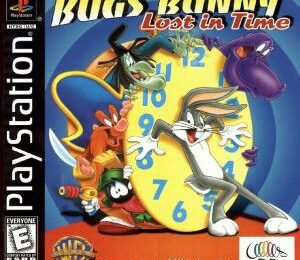
Bugs Bunny: Lost in Time is a 1999 platform video game developed by Behaviour Interactive, published by Infogrames, and released for the PlayStation and Microsoft Windows. It is based on the Bugs Bunny and Looney Tunes characters by Warner Bros. Entertainment. The game follows the titular character, who finds himself in a time slip and is tasked with gathering clocks in order to return to the present.

An indirect sequel, Bugs Bunny & Taz: Time Busters was released for the same platforms in November of the following year.

Plot
The game stars Looney Tunes cartoon character Bugs Bunny, who finds and activates a time travel machine (mistaking it for a carrot juice dispenser) after taking a wrong turn at Albuquerque intended for Pismo Beach. He ends up in Nowhere, home of a sorcerer named Merlin Munroe. Merlin then informs Bugs that he is lost in time, and that he must travel through five different eras of time in order to collect clock symbols and golden carrots, which will allow him to return to the present.

Gameplay
The game finds the player (Bugs Bunny) in a race to collect time clocks. To progress in the game, Bugs must complete stages and various objectives which earn them; stages may also contain clocks out in the open in which Bugs can collect, as well as golden carrots. If the player meets a certain threshold of clocks or golden carrots, they’ll be able to unlock new stages or a new time era (serving as the game’s hub worlds), which become accessible by means of a time machine.

The player starts off in an area titled “Nowhere”, which acts as a tutorial level; Bugs will learn the basic moves he needs to use to progress through the game. He can kick, jump, pick up objects, roll, jump into rabbit holes to move underground, tiptoe to avoid alerting other enemies, climb ropes, and use his rabbit ears like propellers to slowly descend to the ground from high places. Bugs can also move some objects to get to certain places. Enemies in the game are mostly simple to beat. Some can be defeated with a kick or a jump, while others may require Bugs to be chased by an enemy until they run out of breath, then they can be kicked in the back. There are also special abilities for Bugs to learn from Merlin much later as he progresses through the game.

While in the time machine, there are five different eras (spanning 21 levels in total) for Bugs to visit. They are the Stone Age, Pirate Years, The 1930s, Medieval Period, and Dimension X. Each level has a varying amount of clock symbols and golden carrots for Bugs to find. There are also normal carrots for Bugs to pick up, which act as his health. Carrots can be collected by finding them scattered in a level. He can hold up to 99 carrots. After completing a level, Merlin will appear and the player can decide if they wish to save their progress up to that point.

Tagged : / /